
What is an Anal Fistula?
An anal fistula is a small tunnel that develops between the inside of the anus or rectum and the skin near the anus. It most often forms after an anal abscess (a pocket of infection) drains but leaves behind a persistent passage.
The diagram below shows an anal fistula, and points out the different anatomical structures to be aware of as you speak to your surgeon about treatment options.
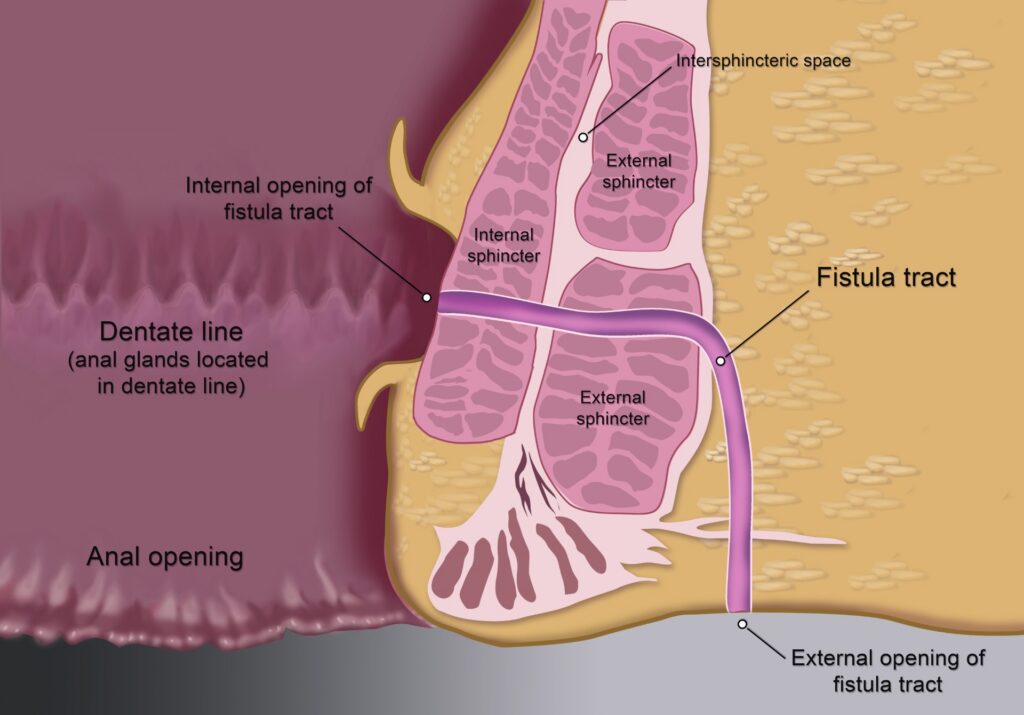
The Anatomy of an Anal Fistula
Understanding the parts labeled in a picture of a fistula can make conversations with your surgeon easier, since these are the terms used to describe where a fistula sits and why it can be challenging to treat.
- Anal opening: opening of the anus.
- Dentate line: a border inside the anal canal that separates its upper and lower portions. The small anal glands are located here.
- Anal glands: tiny glands at the dentate line that produce fluid. When one becomes blocked and infected, it is the usual starting point of an abscess and, later, a fistula.
- Internal opening of the fistula tract: the inner end of the tunnel, where the fistula begins inside the anal canal (typically at the dentate line).
- Fistula tract: the tunnel itself, running from the internal opening through the surrounding tissue to the skin.
- External opening of the fistula tract: the outer end of the tunnel, where it reaches the skin near the anus and may drain.
- Internal sphincter: the inner ring of muscle that helps keep the anal canal closed. It works involuntarily.
- External sphincter: the outer ring of muscle around the anal canal, which you can consciously control. Together with the internal sphincter, it maintains continence.
- Intersphincteric space: the area between the internal and external sphincter muscles. A fistula tract often passes through this space.
Because a fistula can pass through or near the sphincter muscles, its exact path matters a great deal when planning treatment. Where the tunnel sits in relation to these muscles is one of the main factors a surgeon considers.
Anal Fistula Treatment
There is no single standard treatment for anal fistulas, and the right approach depends on the individual fistula and its relationship to the sphincter muscles. For a comparison of the available surgical options, see Clinical Data.