Anal Fistula Background 

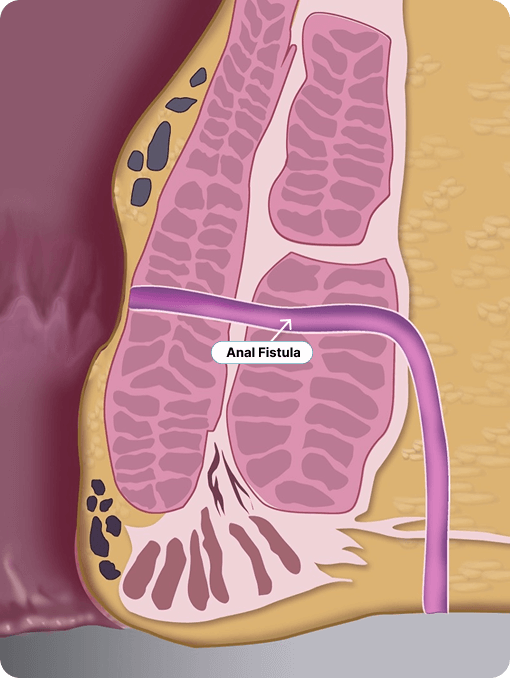
Approximately 90,000 anal fistula procedures are performed in the US each year. People suffering from anal fistulas are generally between 18-50 years old, with men more commonly afflicted than women. The symptoms usually begin with a painful perirectal abscess that drains itself to the buttocks or requires a surgery for drainage. The result is the formation of the fistula tract through the sphincter complex out to the perianal skin. These symptoms include foul smelling drainage, pain and discomfort. 

A male doctor in a white coat and stethoscope smiles while discussing Signum Surgical’s solutions with a seated male patient in casual clothing during a medical consultation in a bright office.
A medical illustration showing a cross-section of the rectal area with a labeled anal fistula, marked by a purple tract connecting the anal canal to the skin surface, highlighting the condition often treated by Signum Surgical solutions.

Surgical Treatment 

The treatment of anal fistulas is complex and there is no current gold standard treatment. Multiple surgical procedures have been developed with the intent to close and heal the fistula, prevent recurrence and preserve continence. These procedures include performing an endoanal flap to cover the internal opening, a LIFT procedure which ligates the fistula tract, insertion of cutting setons, fistulectomy and fistulotomy. Most of these procedures require extensive dissection which can lead to injury of the sphincter muscles causing incontinence and often require 2-4 follow up surgeries due to failed healing with recurrence. Other technologies were developed to occlude the fistula tract, using plugs or fibrin glues. Although these devices did not require tissue dissection, the outcomes were poor, leading to device migration, infection and recurrence. 

Current Options vs BioHealx

BioHealx

Mechanism: Tissue apposition closure

BioHealx Assisted Fistula Treatment
BAFT

No dissection.
No damage to sphincter.

Negligible risk of incontinence.

Efficient & Accurate implant delivery. Excellent healing – 84.4%

Traditional Surgery

Mechanism: Patch internal opening or divide the fistula tract / sphincter

Endoanal flap, LIFT, Fistulotomy with sphincter repair, cutting secton

Extensive dissection.
Potential damage to sphincter.

Predictable risk of incontinence.

Technically challenging.
20 – 40% failure rate.

Failed Occlusion

Mechanism: Fistula ablation, Internal filling of fistula tract

Laser ablation, plugs, glue

Extensive dissection.
Potential damage to sphincter.

Extensive dissection.
Potential damage to sphincter.

Extensive dissection.
Potential damage to sphincter.

Contact Us

Please get in touch using the form or reach out directly via the contact details provided.

GENERAL ENQUIRIES

"*" indicates required fields

This field is for validation purposes and should be left unchanged.
Name*